Distribution Will Eat Sculpting
We have watched two founders build a variant of the same pipeline in 2025 and 2026, and neither of them thought of it as a pipeline at first. Both cases here are composites of several Sliday engagements; the specific tooling and client identities are omitted to preserve anonymity. Both were running B2B companies at the sharp end of their respective sectors. Both had sculpted a product they were proud of (in one case a compliance tool sitting on top of a Lovable-generated prototype, in the other a scheduling layer for a regulated industry, its team starting at 07:00 Central European Time so the founder could close her laptop before the school run), and both, within a month of launching, discovered that the product was not the problem. Nobody knew they existed. Nobody was going to know they existed by accident. And the cost per click on the one paid channel they both tried had, in the months while they were building, quietly doubled.
The response each of them landed on, independently, is worth describing carefully because it is going to matter for the rest of this chapter.
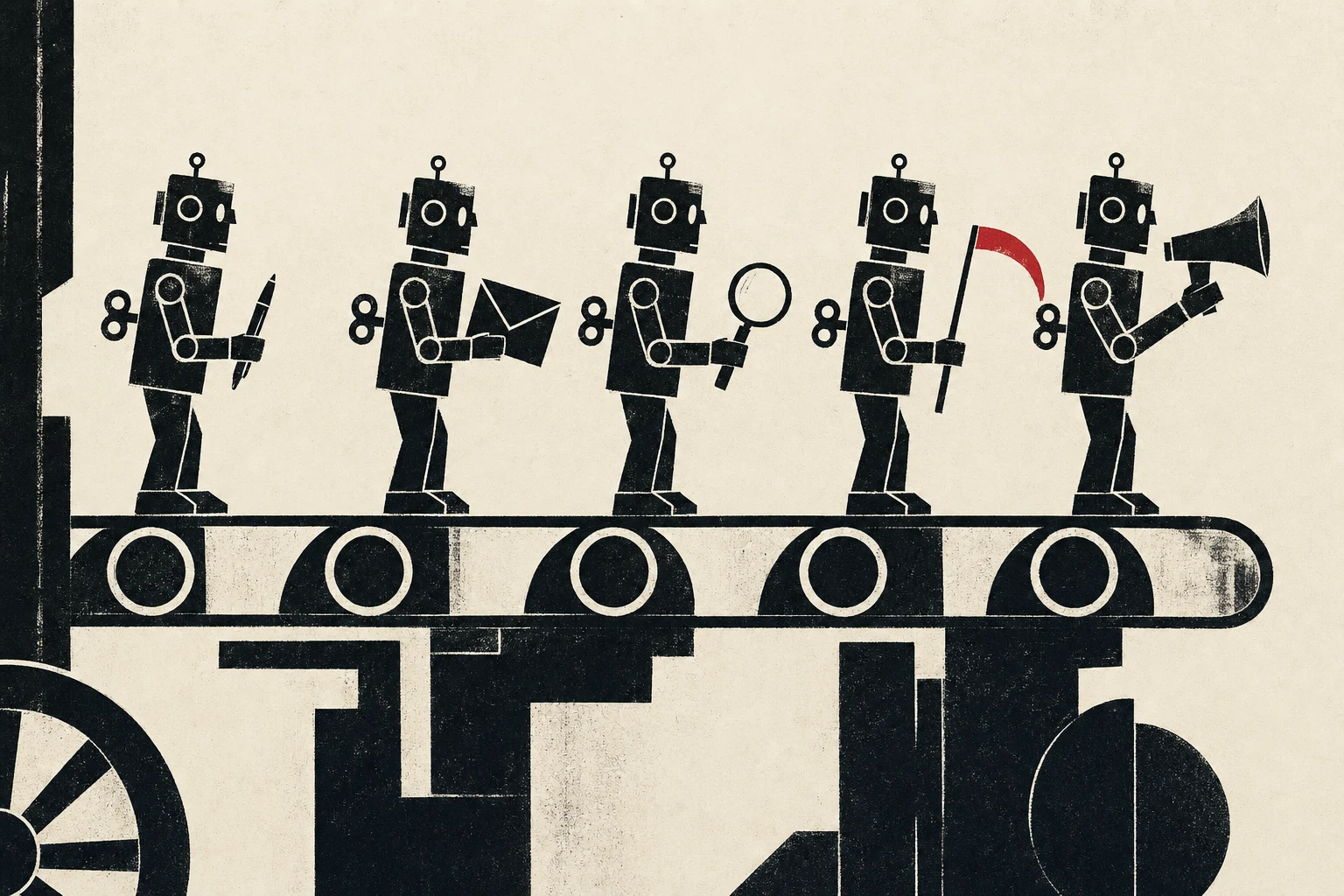
They built an agent team whose only job was to find, earn and keep attention. Not a marketing department. Not a content strategy. An agent team. Five roles, in both cases, roughly equivalent even though the tooling was entirely different.
The first role was a content-generator: an agent that produced blog posts, comparison pages and long-tail answers to the questions a prospective customer might type into a search bar at eleven at night. Draft quality was mediocre on arrival; the founder had a second agent, a light editor, to sand the worst edges off before publication. Output ran in the tens of posts per week.
The second was an ad-dispatcher: an agent that took the top-performing content of the previous seven days, generated three to five ad variants against it, booked them into whichever paid channel was cheapest that morning and set a small budget per variant.
The third was an attribution-watcher: an agent that sat on analytics, matched clicks to source and attached a live cost-per-acquisition number to every single piece of content and ad variant in flight.
The fourth was a killer: an agent whose only behaviour was to shut things down. Underperforming content got depublished. Ad variants below threshold got paused. No hesitation, no sunk-cost reasoning, no favourites.
The fifth was a doubler: the mirror of the killer. It took the top decile of performers, cloned them into three or five variants each and pushed them back into the dispatch queue with a larger budget.
The founders set policy once a week. Budget caps, brand voice guardrails, lists of claims the content-generator was not allowed to make. Then they walked away. The pipeline ran overnight, over the weekend, over the fortnight one of them took off for his daughter’s school holidays, and continued to produce a steady stream of customers at a cost per acquisition neither of them had been able to achieve by hand.
That is what works. Now the hand-waving.
The content the generator produces is, on a good day, competent. On a bad day it is the kind of thin, slightly hollow prose that everyone reading this book can already smell from a hundred metres. Both founders have had to intervene when the generator started confidently stating things that were not true about their own product. The killer-and-doubler loop is only as good as the attribution-watcher feeding it, and attribution in 2026 is still a mess of cookies, fingerprints and guesswork held together by optimism. Neither pipeline has yet handled a reputational incident; the day one of these agents publishes something the company has to apologise for is coming, and no one has a clean protocol for it. The founders are, in effect, running a small newspaper whose entire staff is on trial.
But it works. More customers arrive than used to arrive. The cost per customer is lower than it was. And (this is the bit that matters for our purposes) the founder’s time is not consumed by the pipeline. She checks it on a Monday and again on a Friday. The rest of her week is spent talking to the customers the pipeline has produced.
Before you start an agent content pipeline, write three policy documents and keep them short: what the pipeline is allowed to claim about your product, what topics it must not touch, and the condition under which a human reviews output before publication. Without those three documents, the pipeline runs without brakes. Set the guardrails once; then read the output once a week rather than every hour.
This is what is coming for our side of the table next.
The argument of this book has been, up to this point, that Sculpting is the work: the reading, trimming and hardening of an over-produced prototype into something that can be run in production. The studio’s value sits in the editorial act. We have spent the book to this point building out what that looks like in practice: the taste, the subtraction, the tests worth writing, the abstractions worth not building.
The next horizon is two to three years out, which in this industry means 2028 or 2029. By then, on every current signal, the hardening work we have described is going to be largely agent-executed.
The Sculptor stays, and the thing she currently does with her own hands (reading the prototype’s code, noticing the duplication, writing the tests around the authentication layer, pulling the secrets out of the repository, tightening the database schema) is going to be work an agent team can do under her supervision. Bain & Company’s Technology Report 2025, which is worth reading in full, sets out a capability ladder in which loosely coupled multi-agent systems are still, in their phrase, on the whiteboard, and expects five to ten per cent of technology spending to go to agent foundations over the next three to five years.1 Reading that as a 2028-or-2029 arrival for most enterprises is my arithmetic, not their forecast. The signals are there now: coding agents that can hold a whole repository in context, test-writing agents that can achieve modest coverage without human nudging, review agents that can catch a meaningful fraction of the issues a senior engineer would catch. None of these are finished. All of them are improving on a quarterly rhythm.
If that trajectory holds, and we think it does, then the Sculptor’s day changes shape again. Today she reads the prototype and trims it. In 2028 she sets the quality gates (the tests that must pass, the abstractions that are forbidden, the dependencies that are not allowed in, the performance floor, the security posture) and an agent team does the trimming inside those gates. She reviews the diff, not the code. She overrides when the gates are wrong. She closes the loop on the handful of decisions the agent team cannot or should not make on its own.
This is, if anything, more skilled work. Writing a good quality gate is harder than writing good code, because a quality gate has to hold up against an adversary that never tires and never learns shame. But it is a different shape of work, and it requires a different kind of studio to deliver it.
The current conversation about agentic development keeps missing one thing. If we can all do it — if every studio in the market can set a quality gate and supervise an agent team doing the hardening — then the hardening is no longer what anyone is paying for. It is a commodity. Some studios will be better at it than others, and the better ones will charge a premium for a while, but the floor of what is achievable is going to rise quickly and the premium will compress.
The question becomes: what are clients paying us for, when everyone can Sculpt?
The answer, we think, is the bit we have been understating for twenty chapters. They are paying us to be findable. They are paying us because a friend of a friend said to take our call. They are paying us because someone on their board read something we wrote in 2019 and remembered it. They are paying us because we have, over seventeen years, accidentally accumulated the one thing the next three years cannot produce on demand.
A reputation.
The founders we described at the top of this chapter figured this out on their own account, which is why they built the pipelines they built. The Sculpting era had handed them the product. The problem they were solving was how does anyone know my product exists, and why would they trust it when they found out? And the brutal thing about that problem is that the agent pipeline only half-solves it. The pipeline produces the mechanics: the posts, the ads, the clicks. It does not produce the reason a reader takes the post seriously in the first place. That reason lives upstream of the pipeline, in the brand, and brand is not a thing an agent can stand up in a quarter.
Paid acquisition needs a product and an audience worth reaching; an efficient pipeline cannot establish that fit on its own. The pipelines the two founders built are a rational response, and they extract every last point of efficiency out of the mechanics — but neither founder would pretend the pipeline generates attention from nothing. Both amplify an existing signal: a product with users who tell other users, a founder already known in her industry, a company that has shown up at conferences and on podcasts. Strip the signal out, and the pipeline grinds against noise.
The noise arrives at the front door, not in the funnel. Mason Filippi, whose sponsorship platform for racing drivers we have worked on since 2019, listed everything that had got faster in his week and then named the one thing that had got slower: telling a machine-generated approach from a real one. Fake accounts to delete. Sponsorship requests from nobody. An inbox that fills faster and rewards less of the reading. When approaching a stranger costs nothing, being approached is worth nothing, and the only signal that survives the sort is one the sender could not manufacture. A name the reader knows. A person who vouched. Years of turning up.
Two a16z partners circled the same observation in their 2025 writing, Andrew Chen most pointedly in an April newsletter essay on why every marketing channel is failing at once, and Bryan Kim in a June post on consumer AI: the two assumptions that underwrote the last decade of venture-backed software growth — that paid acquisition was efficient at scale, and that organic distribution would do the heavy lifting between paid pushes — are both decaying, the paid channels from age and the organic ones from AI answer boxes.23 What they describe as a venture-capital problem we are reading as a studio problem, because the underlying mechanism is the same: distribution used to come cheap as a side-effect of a good product, and now it does not.
This is the next bottleneck. Not can we build it, because by 2028 everyone can build it. Can we get anyone to care that we built it.
Studios sit in an awkward position here, which is also an opportunity. On the one hand, the supervisory work we have described (setting quality gates, running an agent team) is going to be available to everyone, and the price of it is going to fall. On the other hand, the brand and reputation that decides who gets called in the first place is, for any studio that has been doing good work for a decade or more, already sitting on the shelf. It has not been valued properly, because in the extraction-and-iteration eras the work itself was the differentiator. In the supervision era, the trust is the differentiator, not the work.
What we have been watching in the tail of 2025 and the first quarter of 2026 is the leading edge of studios rebuilding their client-facing surface around this. Some of them are building small, per-client distribution tools (bespoke content pipelines, attribution dashboards, newsletter systems) that sit alongside the sculpted product at delivery and keep the relationship alive past shipping. Others are turning inward, building the pipeline for themselves first, using their own case studies as the content and their own clients as the first amplifier. A few are simply writing more, in public, under their own names, on the assumption that a body of honest writing is the cheapest brand moat available and the one most resistant to being copied by an agent team.

We are making the bet, in how we are spending the time that used to go on scoping and extraction, that the next useful thing Sliday can do for a client is not stop at the sculpted product, but stay in the room for the distribution problem that follows it. It is a tentative, observational bet, based on watching two founders solve it for themselves and noticing the shape of the hole their solution left behind.
Pick one form of public writing your studio can sustain for two years: a weekly case-note, a monthly long-read, a short newsletter. The form matters less than the consistency. A body of honest writing published under your studio’s name is the cheapest distribution asset available and the hardest to copy at speed. Start before you feel ready.
The bet the industry has largely been making — that Sculpting will remain the scarce thing, that the studios good at it will keep charging for it indefinitely — is a bet against the trajectory of the tools. They are coming for Sculpting the same way they came for extraction and iteration. The only sensible position is to assume Sculpting becomes a commodity within three years and to spend the time between now and then building whatever the next scarce thing turns out to be.
The next scarce thing is attention, and under attention, trust.
The studios that survive Sculpting will be the ones that already had a reason for someone to take their call.